Research Highlight from Aisa: 324‑Million‑Year‑Old Amphibious Stem‑Insect Illuminates Insect Terrestrialization
An international research team published findings in Nature, describing a new stem‑group insect Chosha praecursor from the 324‑million‑year‑old Late Mississippian Tesnus Formation in Texas, USA, offering crucial fossil clues about how insects conquered land.
For decades, the specimen was misidentified as a juvenile crustacean. Using cross‑polarized light imaging, scientists uncovered diagnostic insect traits: an ovipositor, a terminal filament, a three‑segmented thorax and six thoracic walking legs. Yet it bore striking primitive features. Segments 1‑9 of its abdomen carried segmented appendages, with hind limbs modified into paddle‑shaped structures absent in modern insects. Morphology and sediment evidence suggest this species lived a semi‑aquatic, amphibious life in near‑shore shallow habitats at water‑land boundaries.
Researchers also re‑evaluated three other puzzling Palaeozoic hexapod fossils: Leverhulmia mariae from Early Devonian deposits and two undescribed specimens from the Mazon Creek Lagerstätte. Phylogenetic analyses place these fossils within early stem‑group insects. Together they bridge the famous 80‑million‑year “hexapod gap”, reconciling discrepancies between molecular‑clock estimates and physical fossil records.
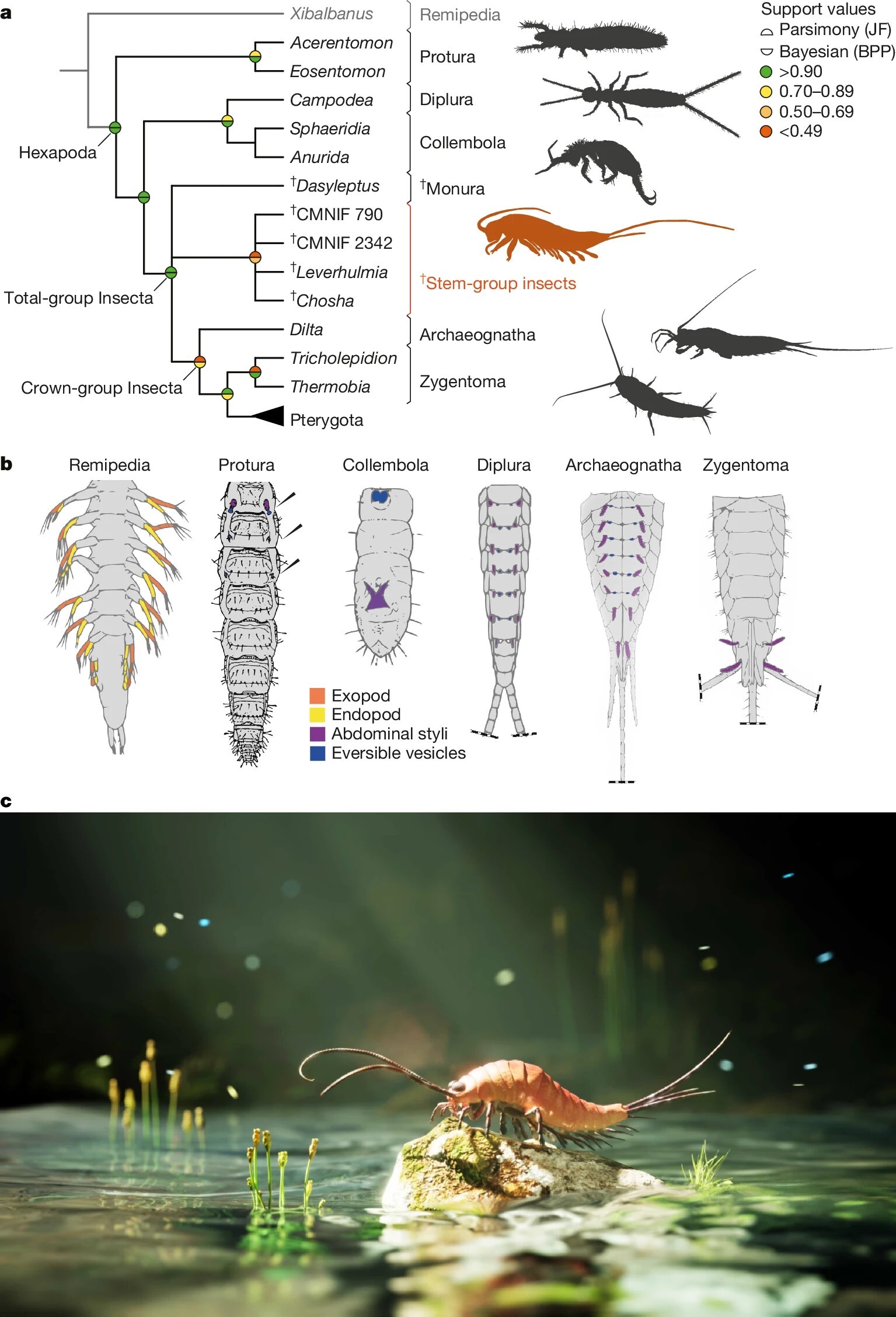
The study demonstrates insect terrestrialization was not a sudden shift. Early insects went through a prolonged semi‑aquatic transitional phase. Abdominal appendages inherited from aquatic pancrustacean ancestors were gradually reduced and lost later in evolution. This discovery revises our understanding of body‑plan assembly, showing the earliest insect body architecture formed gradually during the water‑to‑land transition.
————
References:
Tihelka, E., Vásquez, C., Engel, M.S. et al. Amphibious stem-insect sheds light on colonization of land. Nature (2026). https://doi.org/10.1038/s41586-026-10961-2
Attachment Download:
