Research Highlight from Aisa - Newly Discovered Cambrian “Huayuan Biota” Reveals Life’s Miracle After Mass Extinction
In Huayuan County, Hunan Province, China, a chance event during the construction of a farm road has unlocked Earth’s life secrets buried for 512 million years. The “Huayuan Biota,” discovered by a team led by Academician Zhu Maoyan from the Nanjing Institute of Geology and Palaeontology, Chinese Academy of Sciences, has stunned the scientific community. Published in Nature, this research reveals for the first time how marine life survived and flourished after the first Phanerozoic mass extinction (the Sinsk Event), filling a crucial missing chapter in the epic story of Earth's life.
A Fossil Treasure Trove: Over 50,000 Specimens and 59% New Species
The exceptional preservation and immense scale of the Huayuan Biota are breathtaking. From a pit about 12 meters deep, scientists have collected over 50,000 fossil specimens. Studies have so far identified 153 animal species belonging to 16 major phyla. Astonishingly, 59% of these are entirely new to science. The species diversity from this single excavation site surpasses that of the famous Chengjiang Biota and the Canadian Burgess Shale.
As a “Burgess Shale-type” Lagerstätte, these fossils preserve not only complete animals, including the apex predator “radiodonts” (anomalocaridids), but also exquisite soft-tissue structures like guts, nervous tissues, and gills. This provides an unparalleled window into the true appearance of deep-sea life during the Cambrian.
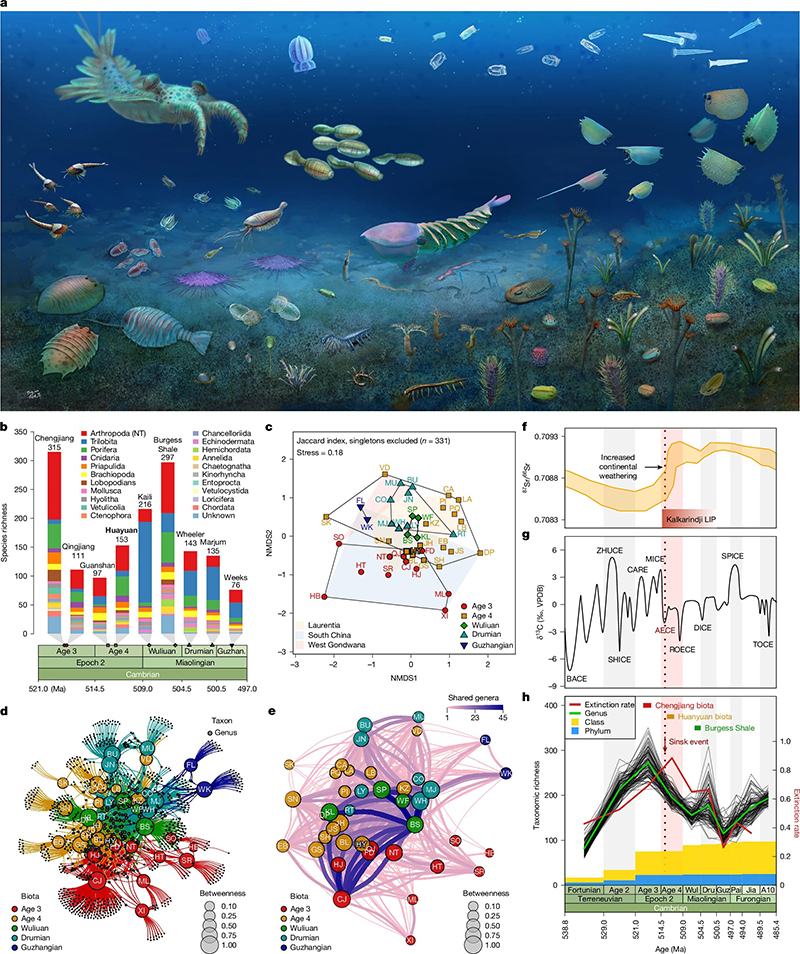
Fig: Ecological and environmental contexts of the Huayuan biota.
Key Findings: Witness to a Deep-Water Refuge and Transoceanic Dispersal
The paramount scientific value of the Huayuan Biota lies in its formation immediately after the Sinsk Event mass extinction 513 million years ago. The research offers a revolutionary insight: while this catastrophe devastated shallow marine life, its impact on contemporary deep-sea ecosystems was limited.
Renowned international expert Professor Robert R. Gaines regards the Huayuan Biota as a global-tier fossil treasure trove on par with the Chengjiang and Burgess Shale biotas. It not only demonstrates life’s resilient resurgence after adversity but also provides profound insights from the deep past for understanding the biodiversity crisis facing our planet today.
——
Reference
Zeng, H., Liu, Q., Zhao, F. et al. A Cambrian soft-bodied biota after the first Phanerozoic mass extinction. Nature (2026). https://doi.org/10.1038/s41586-025-10030-0
Attachment Download:
